Building an app in public, alone
What changes when you write software with no team, no funding round and no secret roadmap — and what it costs.
PUBLISHED SEPTEMBER 12, 2026
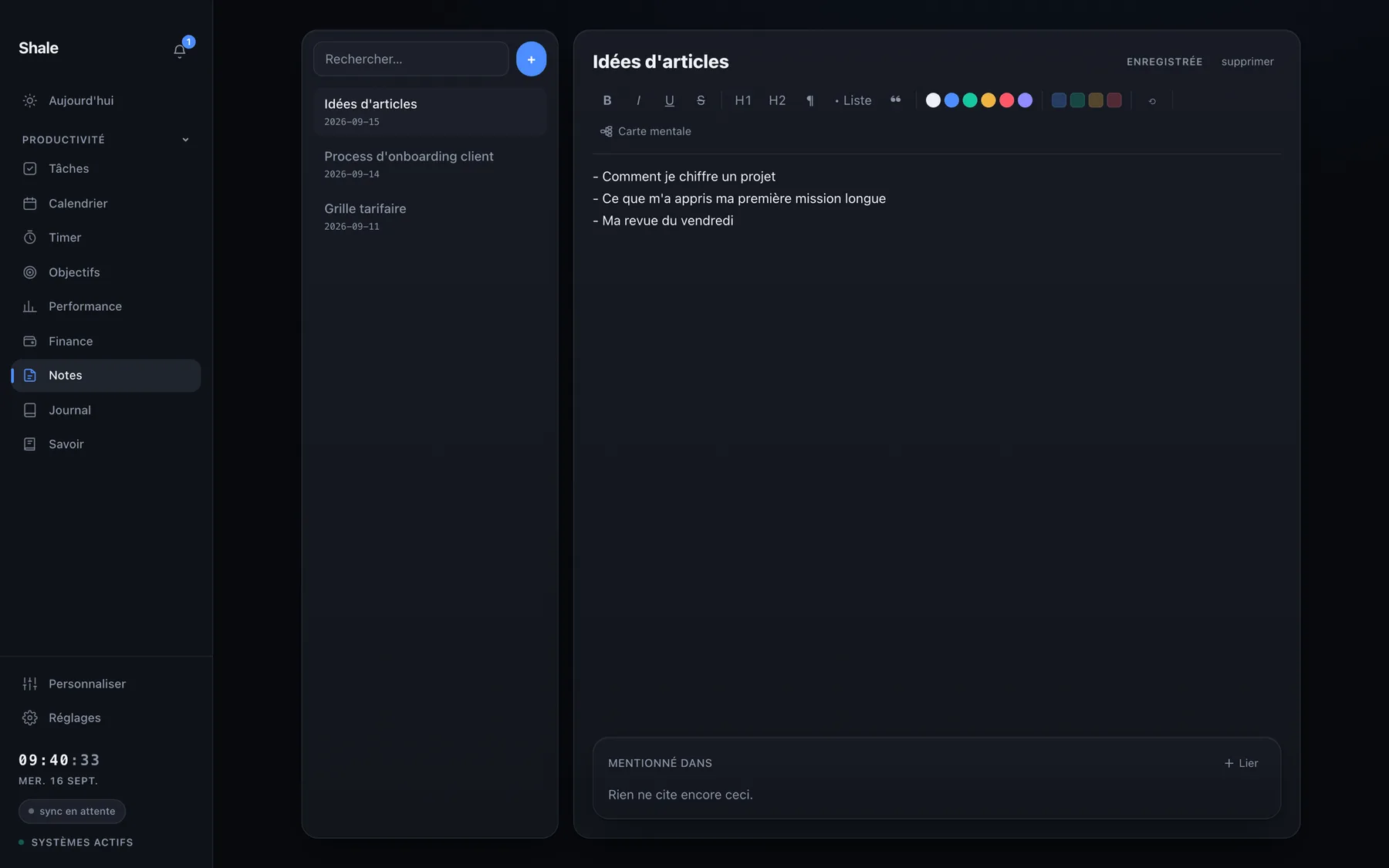
I build Shale on my own. Not in secret: versions ship, the release notes say what changed, and when I fix a defect, I say so too. That’s the part people find odd — why announce a defect rather than let it slip by unnoticed.
The answer is simple. Software paid for by its users has only one debt: to them. Not to an investor waiting for a curve, not to a sales team that promised a feature. That debt is repaid by telling the truth about the state of the product.
This month, the line I reread most is a fix
September brought the calendar, links between notes, tasks and goals, mind maps and invoicing. But in the release notes, the line that matters most to me is a fix: for a few days, a note’s content could show up in the next one when you switched notes very quickly. No note was lost.
I wrote it down anyway. A defect you don’t mention, people end up finding on their own — and they conclude, rightly, that everything else is being kept quiet too.
Building in public isn’t telling your story
There’s a tiring version of this practice: the developer who posts revenue every week, turns every bug fix into a heroic tale and talks more about their journey than their software. That isn’t transparency, it’s marketing in a different tone.
The version I care about comes down to three habits. Say what the product doesn’t do, on the home page, before someone finds out the hard way. Write release notes that include the defects fixed. Answer support yourself, which is the best known way to learn where the product hurts.
What it really costs
There’s no one to tell me an idea is bad. No guardrail, no code review, no meeting — which is both a comfort and a danger.
There’s also the question everyone asks, fairly: what if I stop? The only honest answer isn’t a promise, it’s a technical property. The data file lives on your machine. If development stopped tomorrow, your work would still be on your Mac. That’s why Shale works offline: it isn’t a selling point, it’s an exit clause.
What comes next
The calendar and invoicing just shipped. Next is the iPhone app — the one that exists and runs, but that I refuse to distribute until it’s good. Windows after that, with no date announced, because announcing a date I won’t keep is exactly the kind of thing this way of working tries to avoid.
Every change is dated in the release notes, fixes included.