Why you quit on the ninth day
The drop-off curve is surprisingly predictable. What causes it isn't fatigue — it's having no record of what you've already done.
PUBLISHED JULY 20, 2026
The ninth day is no accident
You know the sequence. On Sunday evening you write out a routine: review yesterday’s trades, briefing before the open, mark the levels, two setups maximum, closing note. On Monday you keep it. On Tuesday too. On Wednesday you skip the closing note, telling yourself it’s the least important one. And somewhere between the eighth and the tenth day, you stop opening the notebook at all.
This isn’t specific to trading. It happens to every routine held together by decision alone. But for an independent trader the effect is harsher, because the market carries on without you: you can abandon your preparation and keep taking positions. Nothing stops you. The penalty arrives later, and never in a form that lets you connect the two.
It isn’t willpower that’s missing
The usual explanation — “I lack discipline” — has one flaw: it’s unusable. If the problem is your willpower, the solution is to have more of it, and nobody knows how that gets manufactured.
Look instead at what changes between day 2 and day 9. On day 2 the routine is new: the effort is carried by novelty, and you don’t even need to remember why you’re doing it. By day 9 the novelty is spent, and all that remains is the question “is this actually doing anything?”. At that precise moment, you look for proof. If you find none, you stop. And that’s rational: stopping an activity whose effects you can’t measure is good instinct, not a character flaw.
It isn’t willpower that’s missing on the ninth day. It’s the proof that the first eight ever happened.
What’s really missing: a record
With no memory of what you’ve already done, every morning starts from zero. You don’t compare this week with the last one — you compare it with an impression, and the impression is governed by your last trade. Three consequences follow, always the same:
- You lose the scale. Eight days kept and two missed feel exactly like two days kept and eight missed, because the only ones you remember precisely are the misses.
- You can’t measure any progress. P&L is too noisy to arbitrate: a disciplined week can end red, a catastrophic one can end green. With no other indicator, you’ll conclude anything at all.
- You restart from zero. Since there’s no visible streak to protect, breaking it costs nothing. The following Monday, you rewrite the same routine in a fresh notebook.
The fresh notebook is the most recognisable symptom. People don’t start over because they lack a method: they start over because they can’t reach the previous one.
Three ways to keep the record without thinking about it
The answer isn’t to document more. Documenting is precisely what you stop doing on the ninth day. The record has to happen during the action, not after it.
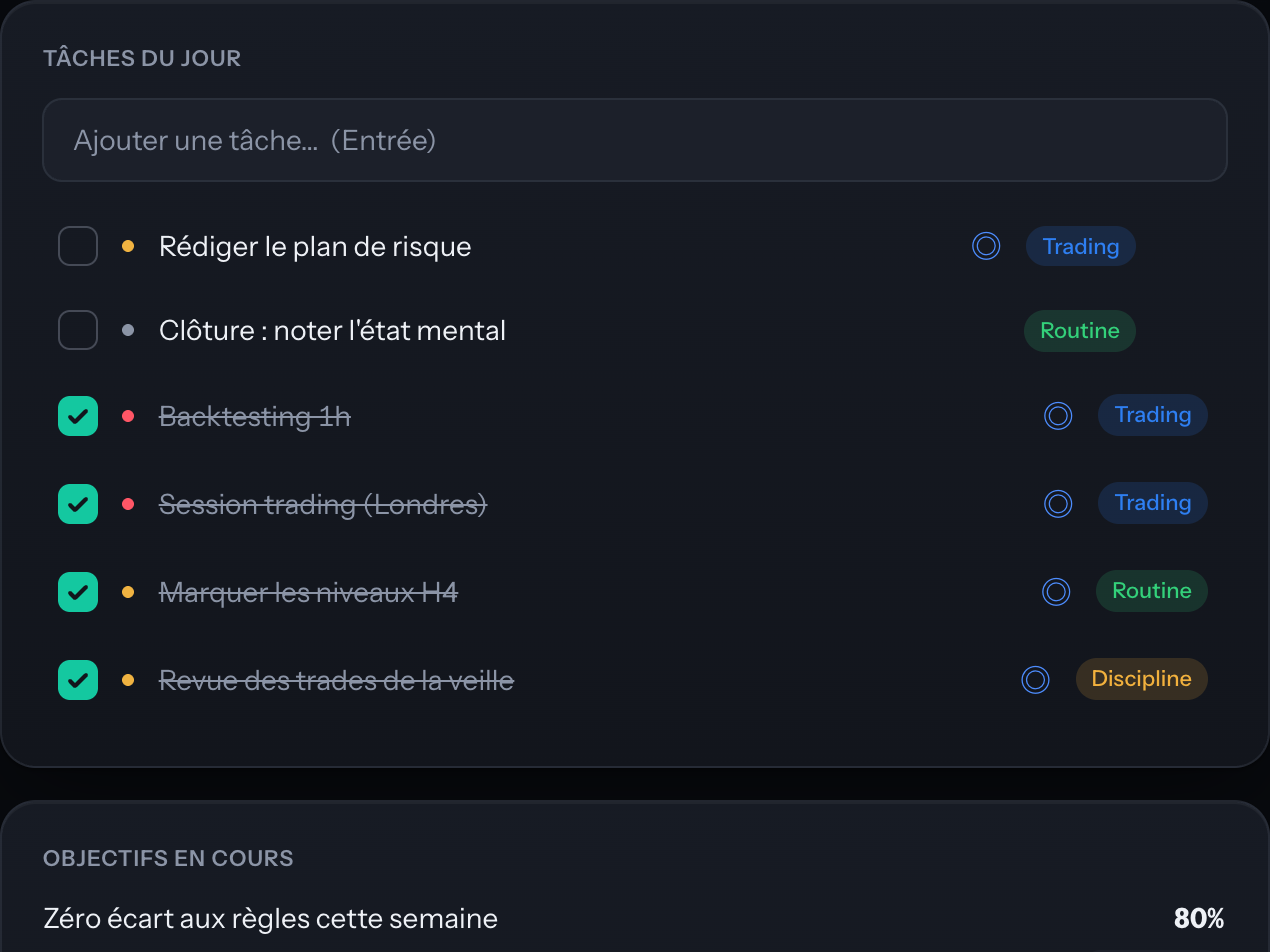
- Tick, don’t write. A routine you kept should be recorded in one click, at the moment it’s done. If recording it takes a sentence, you won’t do it at 6pm after a losing session.
- Measure a behaviour, not an outcome. “Four days out of five with a briefing done before the open” is a number you control entirely. “+2.1 R this week” isn’t. Track the first; it predicts the second.
- Make the streak visible the moment you open up. Not in a statistics tab visited once a month: on the home screen, before any decision. The only place that counts is the one you’re already looking at.
What changes after a month
No transformation. A measurable difference, which is already a lot: the routine no longer vanishes all at once on the ninth day — it erodes slowly and gets repaired, because the break becomes visible the same day. You go from “I stopped three weeks ago without noticing” to “I skipped yesterday”.
That’s the whole gap between a habit you keep and a habit you keep restarting. Nobody needs more willpower. Everybody needs a record.